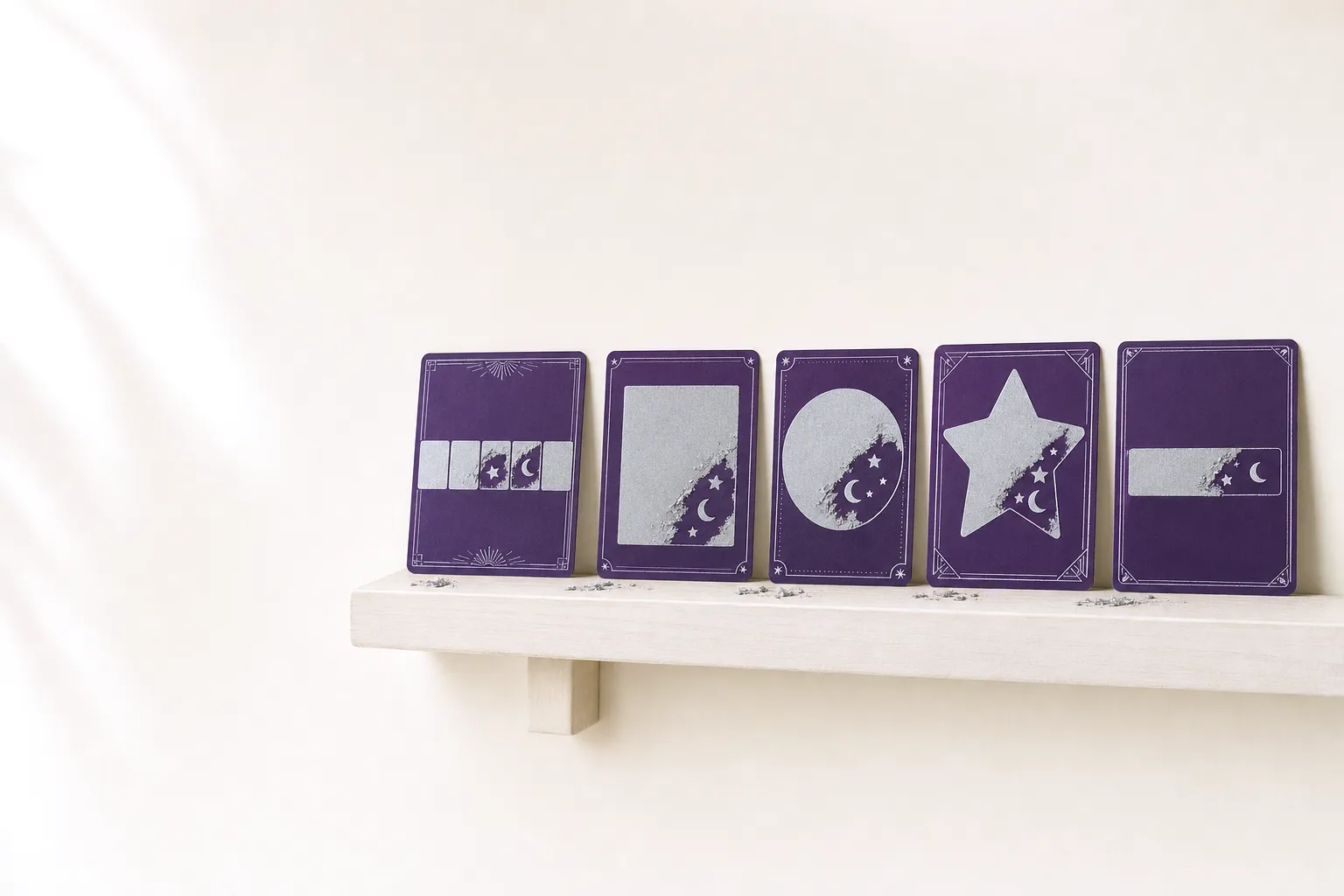
Scratch card games online have more in common than the artwork suggests. Every type hides a result under a graphic, charges a fixed price per card and, over time, pays back less than it takes in. What differs is the layout of the hidden result and what counts as a win.
This page goes through the five main types. It does not recommend one and has no playable examples: UK rules on showing free-play versions of gambling games to UK customers are strict, so everything here is explanation.
Match games
You reveal a grid of symbols, and a prize is paid if a set number of the same symbol appears. This is the closest in spirit to the paper scratchcard: nine boxes, look for three the same.
The prize usually depends on which symbol you match, with a rarer symbol paying more. That is why the prize table is useful here: it tells you how many symbol types there are and which ones carry the top levels.
Number games
Two sets of numbers are compared. One belongs to you, one is the winning set, and a match with any of them pays the prize printed beside it. Some games give several of your numbers a different prize each, so a single card can pay more than once.
The way to read this type is to check how many of your numbers there are and how many winning numbers are drawn. More numbers on either side usually make a match more likely, and a game designed that way tends to pay smaller prizes for each match. The prize table shows how this particular game balances it.
Bingo-style cards
A card of numbers is played against called numbers, and a pattern of matches pays. The format has its own page, because bingo is licensed separately from casino games and offers for the two are often separate. The details are on bingo scratch cards.
Hidden-prize map games
Instead of a grid of symbols, the card shows a map, a board or a set of objects, and you reveal spots to find hidden prizes. One rule applies directly to this format: for UK customers, the Gambling Commission’s technical standards say that where a game needs a predetermined layout, the locations of the winning spots must not change during play, except as provided by the game’s rules. Moving the prize when you reveal a spot, to keep you from finding it, is not allowed.
Themed cards with bonus rounds
Many games borrow a theme, a character or a story, and add an extra stage that is triggered by certain symbols. The extra stage might be a wheel or a second grid with prizes of its own. The theme is decoration; the mechanics are on the information page. A bonus round makes the RTP more important to find, because a large headline prize says nothing about the average return, and the table should make clear whether the bonus-round prizes are included in the stated figure.
What the prize table looks like in each format
| Format | The table usually lists | What to check first |
|---|---|---|
| Match | Each symbol and the prize for matching it | How many symbol types there are, and which carry the top prize |
| Number | A prize for each matched number | How many of your numbers there are, and the prize per match |
| Bingo-style | Prizes for patterns or lines | Which patterns pay, and which are rare |
| Hidden-prize map | A prize for each hidden spot | How many spots you can reveal and how prizes are spread |
| Themed with bonus | Base prizes plus bonus-round prizes | Whether the RTP includes the bonus round |
Five questions that pick a format
- Do you want something simple to read? A match game is the easiest.
- Do you mind a bonus round? It makes the headline prize bigger and the RTP harder to follow.
- How fast do you play? Fast formats pass more stakes through a balance. At six £1 cards a minute, ten minutes is £60 staked (an illustrative pace, not a measured one), so set the limit first.
- How long a run without a prize can you tolerate? A game that pays rarely and large makes long runs normal.
- Is the RTP or the odds published? If neither is, choose another game.
Using them on a phone
A swipe is the intended way to scratch, and not everyone can swipe comfortably. Games that offer a tap or a reveal-all button are easier to use with limited dexterity or a screen reader, and a motion setting helps if animation bothers you. If a game offers none of these and you struggle with it, choose another. The reveal button changes nothing about the result.
What changes between types, and what does not
| What it changes | What it does not change | |
|---|---|---|
| Layout of the grid | How a win looks and how many ways a card can pay | That the result is fixed when you start |
| Prize table | How the money is spread across prize levels | That the total paid out is less than the total staked |
| Bonus rounds | The route to a prize | That each card is a separate paid purchase |
| Theme | How it feels | The RTP |
Two further things stay constant. Nothing you do while scratching changes the result, and the house edge applies to every card whatever its shape. Scratch card odds explains how to read the figures, and the page on RTP goes through the percentage.
How to choose between scratch card games online
When you compare scratch card games online, the type matters less than the price, the published RTP and how often the game pays. Two games can share an RTP and still behave very differently.
Take two invented £1 games, both with an RTP of 90%. Game A pays a prize on one card in four; Game B on one card in ten. Over 100 cards each is designed to return about £90 on average, but Game A spreads it over about 25 winning cards averaging £3.60, while Game B spreads it over about 10 averaging £9. Game B will produce longer runs without a prize, and a short session on it is more likely to end well below £90 or well above it. The figures are illustrative and describe no real game.
That is why the frequency of prizes, where the information page gives it, deserves a look alongside the RTP. You must be 18 or over to play any of these games.
