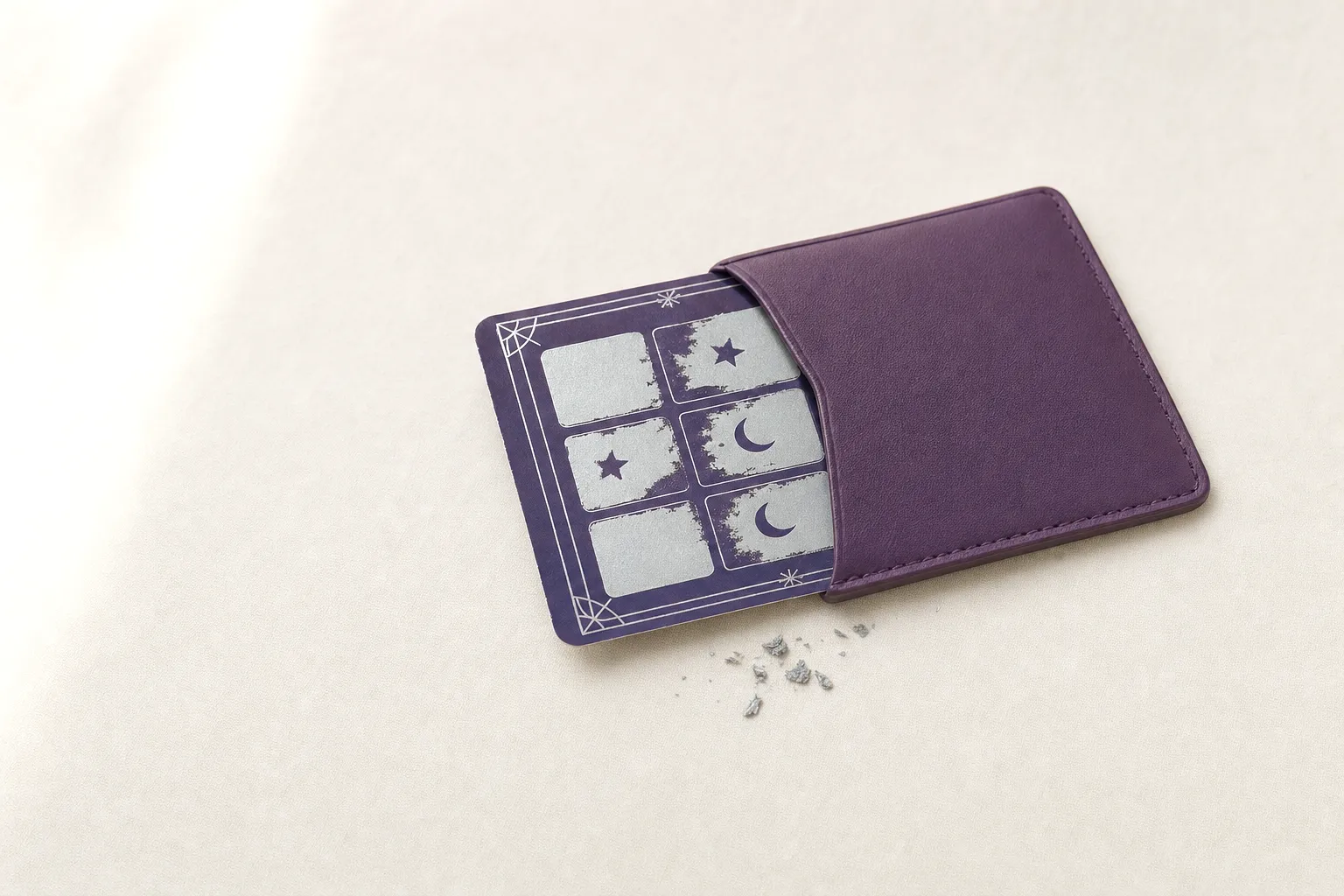
Playing online scratch cards for real money comes down to three questions: what a card costs, how the money moves and what protects you. With online scratch cards, real money changes hands in a transaction with a known shape. You hand over a stake, the game shows a result that was set the moment you started, and over time the operator keeps a share of everything staked. In that respect a real money scratch card is no different from any other paid casino game, and the silver foil on the screen does not change it.
What does differ from game to game is what you can find out before you pay. This page walks through that, step by step, using the two licensed operators checked for this site.
What a real money scratch card costs, in practice
Each card has a price, shown on the game or in its information page. Prices vary by title, and what matters is how fast they add up. An online card takes a few seconds to play, so a modest price turns into a real sum within a quarter of an hour: to take invented figures, one £1 card every 20 seconds is £45 staked in 15 minutes. On a single card the loss looks small, which is why the total is easy to underestimate.
Three habits keep the cost visible:
- Decide the total, not the price. Pick the amount you would be comfortable never seeing again, and treat it as the cost of the session.
- Set a deposit limit first. Every UK licensed operator offers them in the account settings, and a limit set before you deposit is one you cannot talk yourself out of at the moment it matters.
- Watch the clock too. Time-outs and reality checks exist because sessions run longer than planned.
From account to first card
Whichever site a “scratch card real money” search turns up, the steps are the same at any UK licensed one, with small differences in order and wording.
- Register. You give your name, date of birth, address and contact details. The operator checks them against records, and may ask for a document.
- Age and identity checks. UK licensed operators must verify age before a customer can gamble. If the checks fail or cannot be completed, the account stays restricted.
- Set your limits. Deposit limits and time-outs are in the account settings.
- Deposit. The funds appear in your balance, from which card prices are taken.
- Choose a card and read its information. Before you start, open the game’s information page for the price, the prize table and the RTP or odds. If these are missing, pick another game.
- Play. The result is already fixed when the card opens. You can scratch or press a reveal button, and either way the outcome is the same.
- Withdraw. Prizes are added to the balance and can be requested for withdrawal under the operator’s rules.
If a step looks missing, such as no age check or no limit tools, that is information about the operator, and worth acting on.
Two UK sites for scratch card real money play
Both were checked on 6 October 2026. Each held an active Casino (Remote) licence on the Gambling Commission public register that day and has a scratch card section. Each operator’s register page is linked in the cards further down.
| Operator | Company | Where scratch cards sit |
|---|---|---|
 Monster Casino |
ProgressPlay Limited | A Scratch Cards item in the main menu; two titles named on the page were Lost Vegas and Cricket Stars |
 Midnite |
Midnite Limited | Inside the Instant Win section, which held about thirty titles; three of them were scratch cards: Scratchcard Shop, JaXpot 7’s Scratcher and Golden Grand Scratcher |
One practical difference shows at once. Monster Casino puts scratch cards in the menu, which makes them quick to find. At Midnite you have to know to look in Instant Win, and most of what you find there is not a scratch card at all: titles such as Mines, Plinko and Spaceman are different instant games with different rules. A reader who wants scratch cards specifically and nothing else will find Monster Casino the easier of the two to use, going by what the pages show.
What this page has not checked: how the games play, how quickly prizes are paid, how support responds, or the current welcome offers. Those change often and are deliberately left out.
How to read the terms before you pay
The terms are where most of the surprises sit, and they are short enough to read in a few minutes. Bonuses have their own page on wagering requirements. Look at four things.
Which games count. A bonus or offer lists the games it applies to and how much each contributes. Scratch cards sometimes count for less than other games, or not at all.
The wagering requirement. This is the amount of stake that must be played before bonus-linked funds can be withdrawn. The higher it is, the longer funds stay locked.
Time limits. Offers expire. A deadline that passes before you finish the requirement can cancel the bonus funds.
Withdrawal rules. Look for a minimum withdrawal, processing times and identity checks. These apply to prizes too.
UK advertising rules expect the significant terms of an offer to sit close to the headline, not several clicks away. If they are buried, treat the offer with caution.
Playing online in the UK: the rules that protect you
A few rules shape what you see in scratch card real money play, and they set the minimum to expect from any licensed site.
- Licensing. An operator offering games to people in Great Britain must hold a Gambling Commission licence, and you can check its status on the public register.
- Fair games. Games must be implemented fairly and as described to the customer, and operators must give information on how winners are determined and the return to player or the probability of winning events.
- Age. You must be 18 or over. Under-18 accounts are closed.
- Self-exclusion. Online operators with a UK licence must take part in GamStop, the free national scheme.
- No credit cards. Credit cards cannot be used to gamble with UK licensed operators, as set out under payments below.
None of this removes the house edge. It makes the terms visible and gives you tools to stay in control.
Scratch cards next to slots and other instant games
The same lobby usually holds scratch cards, slots and a shelf of other quick games. They look alike on screen but work differently. A scratch card gives one fixed result per card and asks nothing of you after you choose it. A slot also settles each spin on its own, but play runs spin after spin, often with features layered on top. At Midnite, the Instant Win section also holds games such as Mines and Plinko, where choices made during the round change how risky it is.
For anyone playing for real money, the useful comparison is speed. The shorter the round, the more stakes pass through your balance in an hour, and a house edge applies to every one of them. Scratch cards are not special on that score; they are simply easy to repeat. One point in their favour is that no decision you make changes the result, so there is no skill to overrate.
Paying in and getting paid out
The full picture is on the page about payments and withdrawals. In short, operators accept different payment methods, and the list is on their payments page, not on a game screen. Debit cards, e-wallets and bank transfers are the common ones, and some sites also take pay-by-phone methods.
Credit cards are the exception that applies everywhere. Since 14 April 2020 the Gambling Commission has banned the use of credit cards to gamble with UK licensed operators, for all forms of remote gambling. E-wallets such as PayPal, Skrill and Neteller can only be accepted if the operator can stop a credit card being used to fund them. If a site offers to take a credit card for online scratch cards, real money slots or any other game, it is not following UK rules.
Withdrawals usually follow three conventions, all set out in the terms: prizes go back to the method you paid with where possible, the name on the payment method has to match the name on the account, and the operator may ask for identity documents before the first withdrawal. Processing times are stated in the operator’s terms, and they are a fair thing to read before the first deposit rather than after the first prize.
Mistakes that cost more than the cards
- Counting a price-back as a profit. A card that returns its price has left you level. Over a session it is easy to see ten of these as ten wins.
- Taking a bonus without reading which games count. Scratch cards often contribute little or nothing towards a wagering requirement, and the bonus can lock funds you wanted to withdraw.
- Playing on a lookalike site. Check the address and the operator’s footer, then match the account number to the Gambling Commission register. Copycat sites exist, and there is more on fake scratch cards on a separate page.
- Playing late, tired or upset. Judgement slips, and the card price stops feeling like real money.
- Moving the limit up in the middle of a session. The point of a deposit limit is that it was set when you were not tempted.
Staying in control
Sites with online scratch cards for real money lead straight to the games; the controls below are easier to miss, and they only help if you set them before the first card.
- Set a deposit limit that you could lose without it affecting anything else.
- Turn on reality checks if the operator offers them.
- Take a break if you notice yourself chasing a loss, playing when upset, or hiding the spending from anyone.
- Use the time-out tool for a day or a week when a session stops feeling like entertainment.
GamStop lets you exclude yourself from every participating UK licensed online operator for six months, one year or five years, and it is free. The National Gambling Helpline, run by GamCare, is free and confidential on 0808 8020 133, open 24 hours a day, and also offers live chat.
How the operator checks were done
Each operator in the table above was checked on 6 October 2026. The company name and Gambling Commission account number were read from the operator’s own footer, the account was looked up on the public register to confirm an active Casino (Remote) licence, and the scratch card section was opened to read the titles listed. Monster Casino and Midnite are the only two operators checked; many others exist and were not. The register pages are linked in the operator cards below, and the same checks are described on the page about how operators are rated. Anything not stated here, including bonuses, was not verified.
